
The moment you buy a camera, it starts losing value. A body that costs $3,500 today will be worth less next year, less the year after, and significantly less in four years when the next generation has made it feel dated. That depreciation happens whether the gear sits in your closet or goes out on a shoot every weekend.
Renting your gear on Sharegrid doesn't stop depreciation. But it turns a losing asset into one that pays you back while it loses value. That's the core argument for listing your gear, and it's a strong one. The question is whether it's actually working for you, and that's where most Sharegrid owners have no idea where they stand.
Your gear is depreciating whether you rent it or not
Most photographers and filmmakers think about gear purchases in terms of what they cost. The more useful frame is what they cost over time.
A camera body purchased for $3,500 and held for four years might be worth $2,500 at resale. That's $1,000 in depreciation regardless of how much or how little it was used. The question isn't whether that loss happens. It's whether rental income offsets it.
If that same body earns $1,000 in net rental income over those four years, it has essentially paid for its own depreciation. You still own the asset. You got full use of it for your own productions. And the net cost of ownership approaches zero.
That's not a hypothetical. That's the actual math behind why renting on Sharegrid makes sense for gear you already own and plan to keep using.
The honest caveats
Renting on Sharegrid is not passive income in the way people sometimes imagine it.
There is real overhead. You are coordinating handoffs, managing availability, inspecting gear on return, and occasionally dealing with damage claims. In high-demand markets like Los Angeles, New York, and San Francisco this overhead is manageable against strong booking volume. In secondary markets the same effort produces significantly less return.
Sharegrid also constrains your pricing more than most owners realize. The platform gives you pricing guidance based on comparable listings and actively pushes listings outside the normal rate range down in search results. This keeps the marketplace fair but it means you have less pricing leverage than you might expect.
And not all gear performs equally. The Sony FX3 topped Sharegrid's own leaderboard for highest earning and most rented product in 2025, with an average rental of $112 per day. But high total earnings on an expensive body don't automatically mean strong ROI. A $6,000 camera earning $112 a day needs a lot of bookings to recover its cost. The total earnings number and the ROI number are telling you different things.
The gap that prevents most owners from knowing where they stand
Here is the problem. Sharegrid's native dashboard does not show you any of this.
What you get is a monthly revenue chart, a list of past rentals. There is no item-level view anywhere on the platform.
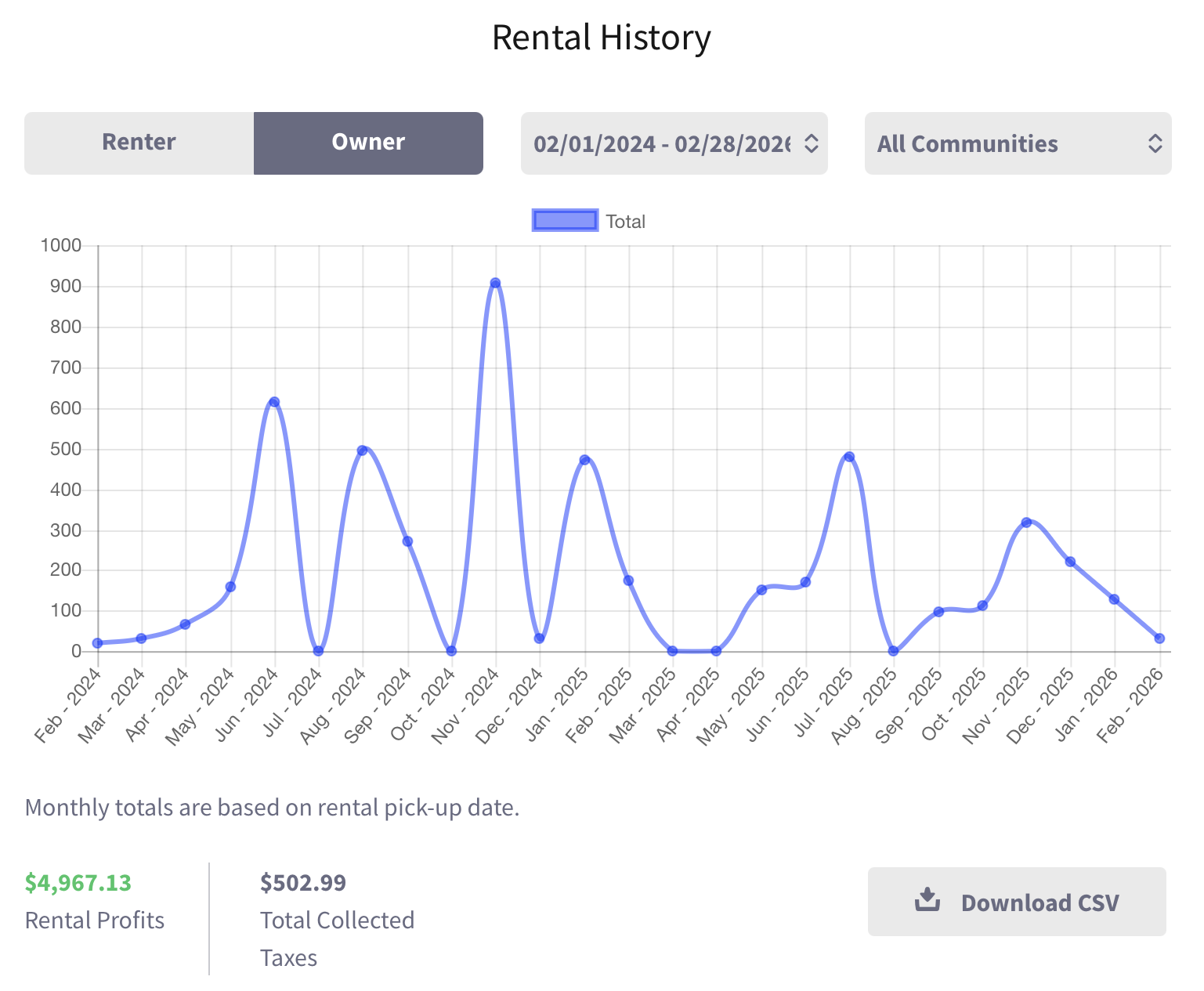
This means most Sharegrid owners are making decisions about what to buy, what to keep, and what to sell based on their total monthly payout rather than the actual performance of individual items. Those are very different numbers and they lead to very different decisions.
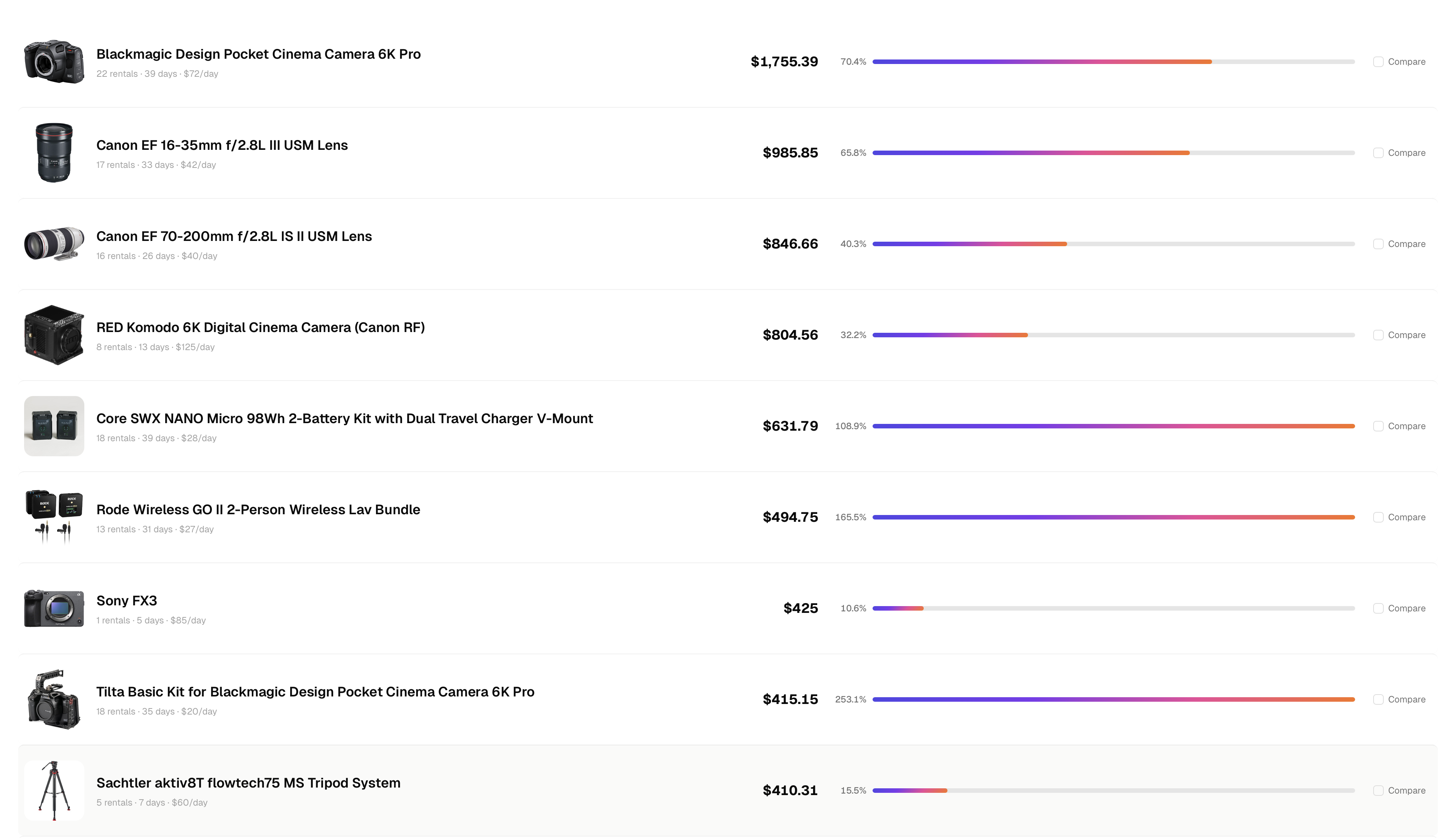
The package attribution problem makes this worse. When multiple items go out together as a package, Sharegrid logs it as a single transaction. The revenue isn't allocated to individual pieces. If your camera, lens, and follow focus rent as a kit every weekend, you cannot tell from the platform data which item is driving that demand or how each one is performing on its own.
So is it worth it
For most gear owners who already own the equipment: yes. The depreciation argument alone justifies listing gear you're not actively using. Any rental income is better than the same asset losing value in a case.
The more precise question is which gear is worth it and by how much. That answer requires tracking ROI by item, accounting for Sharegrid's service fee in your net income calculation, and being realistic about payback timelines for high-cost assets.
If you are already on Sharegrid and questioning whether to continue: run the numbers by item before making a blanket decision. It is common to find that a few pieces are carrying the portfolio while others have barely moved. The answer is usually not to stop renting. It's to understand what you actually have.
How to run the numbers
The manual process: export your transaction CSV from Sharegrid, filter by item in a spreadsheet, sum your net earnings per piece, and divide by purchase cost. If your inventory includes package rentals you will immediately hit the attribution problem since Sharegrid logs package revenue as a single line with no item-level breakdown.
If you want to skip the spreadsheet work, Rental IQ was built specifically for Sharegrid owners to solve this. It ingests your CSV, uses your Sharegrid confirmation emails to resolve package transactions down to individual items, and surfaces ROI, payback period, and utilization across your full inventory automatically. The whole point is to give you the item-level view that Sharegrid doesn't.
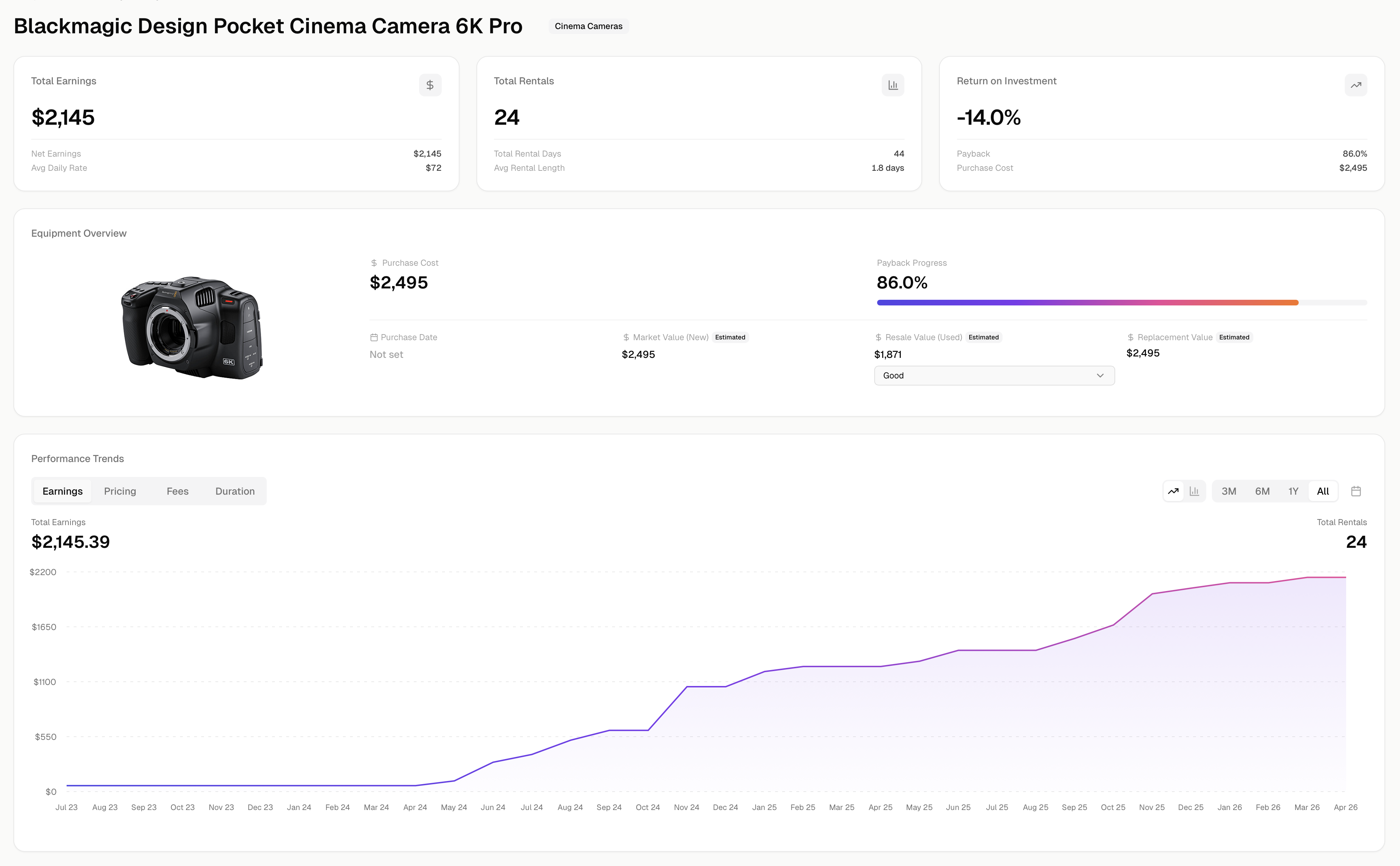
Your gear is depreciating right now. The only question is whether it's earning anything while it does.